
Petaluma City Directory Holdings
The strongest starting point is the free Sonoma County Library digital collection. It combines full scans and excerpted city sections, so confirm whether a volume contains a full Petaluma run or only selected pages. The physical shelf adds editions that are not digitized, but the library has not published a gap-free annual inventory after the verified runs below.
| Collection | Years | Where Held | Access |
|---|---|---|---|
| Polk-Husted Santa Rosa, Petaluma and Sonoma County Directory | 1909-1910; 1911 also named in the city bibliography | Sonoma digital collection and library holdings | Free scan and page images |
| Press Democrat Directory of Santa Rosa, Petaluma | 1924 | Digital local-history collection | Online scan |
| Pacific Telephone and Telegraph directories | 1921 through the 1930s | Digital scans and special collections | Issue-dependent |
| California State Farmers Directory, Sonoma County | 1922-1923 | Library historical collection | Useful rural complement |
| Petaluma, Cotati and Penngrove: A to Z Directory | 1954-1955 | Sonoma County digital collection | Free scan |
| Thomas Guides and physical city directories | Thomas Guides 1953-2007; broader directory guide 1877-present | History and Genealogy Library and Petaluma History Room | Ask for edition-level access |
The year range is a set of verified examples, not a promise that every intervening year survives. A librarian can identify shelf-only volumes, missing issues, and the final printed Polk year.
The Sonoma Digital Directory Viewer
The Sonoma County directories collection uses a viewer with item search, Browse Sections, Summary or Contents or Transcript views, hit and page navigation, zoom, an IIIF manifest, bookmarks, and permitted downloads. A free Quartex account is optional for saved work. The scan is the authority when OCR turns initials or narrow type into the wrong name.
Search the surname first, then inspect the page image and note the title, publisher, printed year, city section, image number, and entry location. A transcript hit can lead to a page, but a missing hit does not mean a person was absent. Try initials, spelling variants, nearby pages, and the street sequence when the volume supplies one.
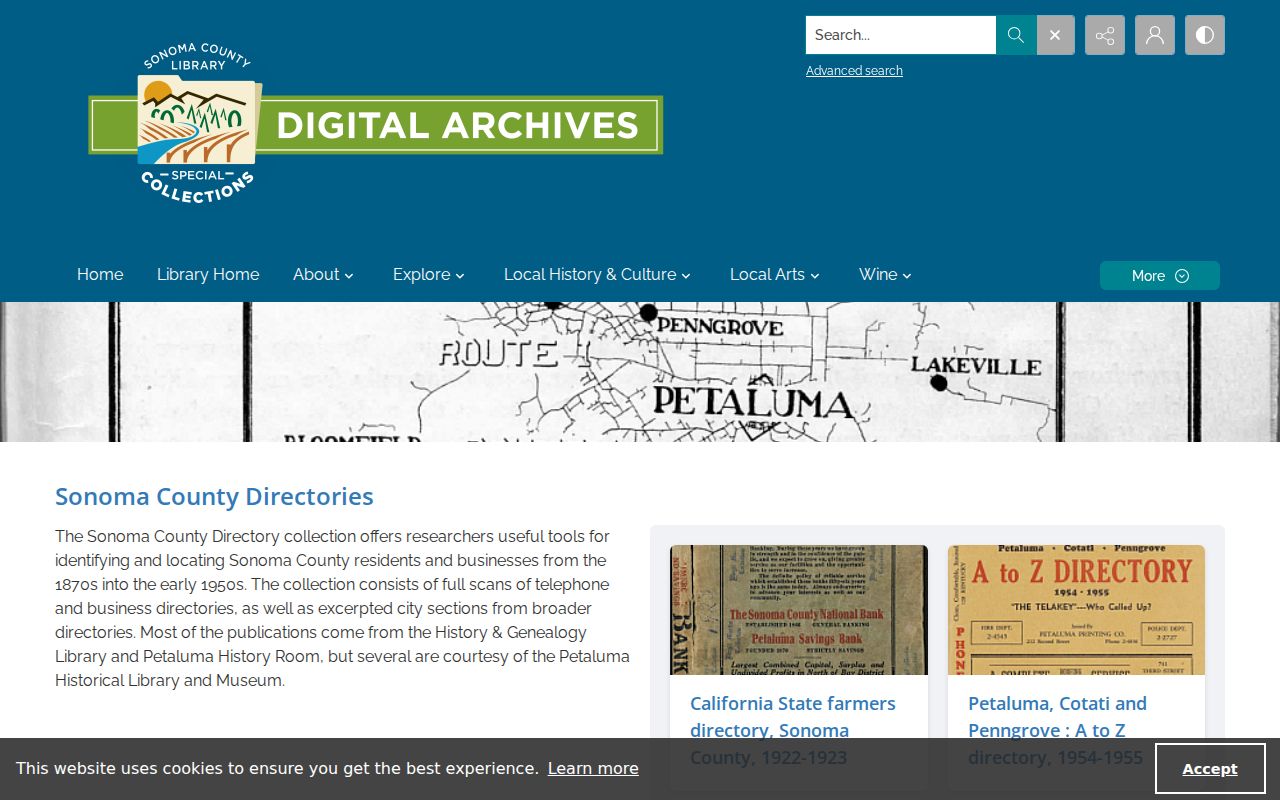
The digitized collection is especially useful for comparing the urban listing with the rural and telephone runs. Save the stable collection link and the printed page citation together.
Petaluma History Room Shelf Help
The Petaluma History Room is inside Petaluma Regional Library at 100 Fairgrounds Drive. The library's Petaluma location page and History Room information provide the service context. The published contact is 707-763-9801, extension 0722. Hours listed for the local-history service are Thursday 10 to 5:30, Friday 10 to 4:30, and Saturday 10 to 1:30, with appointments available. Its holdings include books, manuscripts, newspapers, photographs, maps, clippings, yearbooks, and City of Petaluma municipal records.
The librarian can help trace a house or property, locate an image, and begin a genealogy question. Bring a full name, alternate spelling, date range, street or APN, and the directory edition already checked. The History Room grew from the collections and local knowledge of Ed Mannion and Ed Fratini, giving Petaluma city directory research an archival context that is not visible in a search box.
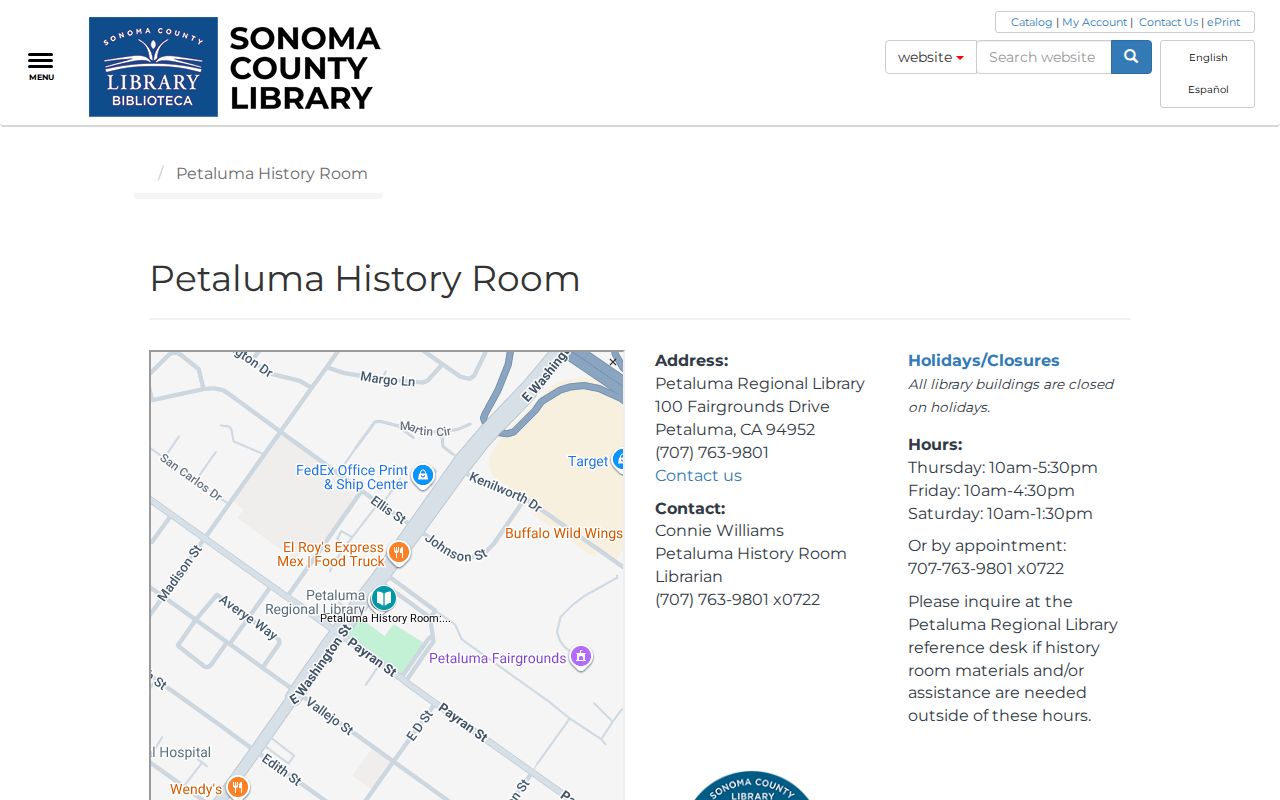
The physical room is the right fallback when the digital collection shows a gap, a damaged scan, or a reference to a shelf-only map, newspaper, or yearbook.
The Petaluma History Room collection page is the source for the local-history image and the published contact details.
Reading a Polk-Husted Petaluma Entry
The inspected Polk-Husted 1909-1910 volume is an alphabetical directory in which a line may carry a surname, given name or initials, spouse or widow notation, occupation or trade, employer, and residence. Business entries can add a firm and business address. Telephone volumes add exchange and number. Rural listings may use a route or post office instead of a street number.
| Name | Indexed surname and given name or initials, sometimes with a spouse or widow note. |
|---|---|
| Residence | House number and street when listed; rural routes and post offices may replace a street. |
| Occupation or trade | A dated clue to identity and affiliation, not a complete biography. |
| Employer or firm | May connect a person to a business address or advertisement. |
| Edition and page | The citation needed to reproduce the exact image and compare another year. |
The entry does not reliably give age, birth date, ownership, every household member, or continuous occupancy. A directory line should be paired with an assessment or deed when title matters and with a census, newspaper, or vital record when family identity matters.
Petaluma Directory Abbreviations
Abbreviations are evidence only after the volume's key is checked. In the inspected example, `r` means resides, `h` house, `bds` boards, and `wid` widow. The same mark can shift by publisher or edition. Photograph or transcribe the key before using a short form in a family-history note.
- Criss-cross directory
- An address-order section that lets a researcher move from a street or house number to a listed name.
- Householder index
- A listing organized around the person or household head, not every person who may have lived at the address.
- Abbreviation key
- The publisher's explanation of short marks such as residence, house, boards, or widow notation.
- Listed occupant
- A person printed at an address for a particular edition. The term does not establish title or present location.
When a name disappears, test the next and prior issue, a changed initial, a remarriage, a move, an unlisted telephone, and OCR errors before deciding that the person left Petaluma.
The 1954-1955 Three-Community Volume
Petaluma, Cotati and Penngrove: A to Z Directory is a useful later anchor because it combines three communities. A search hit may therefore identify a real local person without identifying the incorporated city. Read the locality line, street, post office, and page context before joining it to a modern parcel.
The combined geography also explains why a Petaluma city directory can overlap with rural routes, nearby communities, and a postal city that is wider than municipal limits. Carry the address and locality together into a parcel map or a later Thomas Guide. Do not collapse a shared publication into one citywide resident list.
Note: A directory's title may describe its publication area, while the entry's locality describes where the listed person or business was placed.
Tracing a Petaluma Household by Year
A city directory becomes stronger when the same name, spouse, occupation, and address recur across dated editions. Use one year at a time, preserve the printed spelling, and mark a move or an absence rather than filling the gap from memory. Pair directory years with federal census years through 1950, then use newspapers, assessments, vital records, and later local collections to bridge the intervals.
- Find the earliest plausible entry and cite the exact edition, page, name, address, and companion clues.
- Check the next available issue and note every change in street, spouse notation, occupation, or household form.
- Switch to a street-order or criss-cross section to inspect nearby listed addresses.
- Pair the directory date with the closest census schedule, assessment roll, or newspaper notice.
- Close a death or departure question with an obituary, cemetery guide, probate file, or later directory, while keeping the source dates separate.
A missing entry can reflect an unlisted line, rural enumeration, an issue gap, a name change, or an OCR failure. One absence is not a disappearance.
Sanborn and Census Cross-Checks
Petaluma Sanborn holdings cover 1883, 1885, 1888, 1894, 1906, 1907, 1910, a 1919 correction, 1923, a 1949 revision, and selected 1965 sheets. Their building footprints, materials, uses, and lot positions help test whether a street label or house number stayed in the same place. They do not normally name residents.
Match a directory address to a Sanborn footprint, then compare the result with a census household or an assessment roll. A directory supplies a listed occupant, the census supplies an enumerated household, and a map supplies a structure. The three evidence types answer different questions and should not be merged into one fact.
Petaluma's Directory Shelf Has a Story
Petaluma's local library history adds meaning to the records shelf. The Odd Fellows library began in 1858, its holdings formed the city library in 1867, and the city assumed it in 1878. The Brainerd Jones Carnegie library opened at Fourth and B in 1906 and served until 1976; it is now the Petaluma Historical Library and Museum. The modern regional library also opened in 1976.
That institutional handoff helps explain why city records, local newspapers, directory volumes, photographs, and family papers are split between current public-service pages, the History Room, the History and Genealogy Library, and the museum research collection. A catalog record can be the beginning of a request even when a scan is not online.
The companion newspaper collection is unusually useful for a directory gap. Library access includes the Argus, Weekly Argus, Courier, Daily Morning Courier, and Argus-Courier runs, with digital and microfilm dates that overlap but do not match. Thomas Guides from 1953-2007 can bridge later roads and subdivisions, while yearbooks can add a school or activity clue. Each companion source still needs its own printed date and page citation.
Gaps in Petaluma City Directory Coverage
The verified digital stack is strongest from the 1870s into the early 1950s, with specific Petaluma editions in 1909-1910, 1924, 1921 through the 1930s, 1922-1923, and 1954-1955. The house-history guide reports physical directories from 1877 to the present, but no official public shelf list proves annual coverage or the last printed Polk year.
A compact chronology helps prevent a later edition from being mistaken for a continuous run:
| Period | Directory or companion layer | Use in a Petaluma history |
|---|---|---|
| 1870s onward | Digitized county and local directories | Locate surviving scans, then verify whether Petaluma pages are included. |
| 1909-1910 | Polk-Husted Santa Rosa, Petaluma and Sonoma County Directory | Read names, residences, occupations, and the publisher's abbreviations. |
| 1921-1930s | Pacific Telephone and Telegraph volumes | Compare telephone listings and address clues with other editions. |
| 1924 | Press Democrat directory | Use as a dated local snapshot rather than an annual bridge. |
| 1954-1955 | Petaluma, Cotati and Penngrove A-to-Z Directory | Check the locality line before treating a hit as incorporated Petaluma. |
| 1953-2007 | Thomas Guides | Bridge roads, subdivisions, and later street geography after directory gaps. |
For a missing year, ask the History Room for the edition-level shelf record and check newspapers, yearbooks, assessment rolls, Thomas Guides, Sanborn maps, and the Sonoma County Archives catalog. Record what was searched and what was not. A candid gap is more useful than a made-up continuous run.